

Nonverbal Working Memory as a Predictor of English and ASL Comprehension in Prelingually Deaf Adults
May 25, 2022
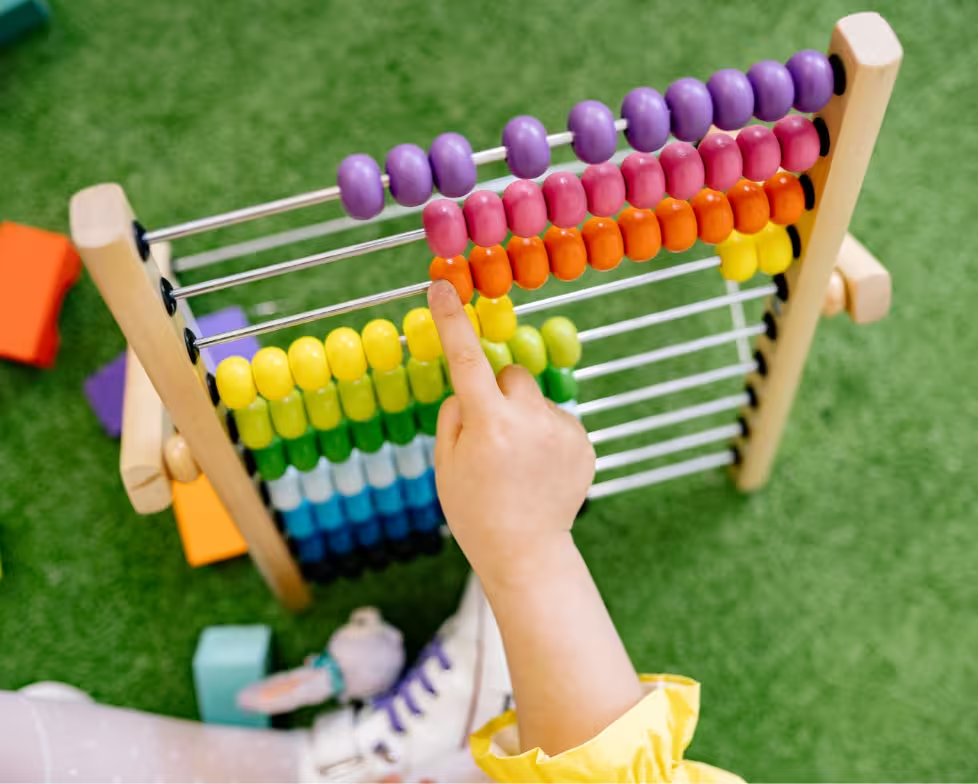
At the protactile Kids lab (PTK), we are conducting a federally funded research study (NIH-NEI Grant: R01EY033761) to better understand how children who are DeafBlind learn about number concepts. We are especially interested in how early language learning connects to other areas of cognition and development, and how the specific experiences DeafBlind children have shape how they attend to important information in their environments and understand the world. In previous studies with prelingual hearing or sighted infants and children, researchers have measured how prelingual infants and young children respond to new or repeated sounds or images to understand what they notice and learn.
These experiments are commonly referred to as (dis)habituation paradigms/tasks, and these studies have shown that (dis)habituation is a common phenomenon and a hallmark of early learning from one’s environment. We adapted this approach to touch, a core modality for DeafBlind children, using carefully designed, gentle vibration patterns that they can perceive through feeling. Working with our partners at Saint Louis University’s Collaborative Haptics, Robotics, and Mechatronics (CHROME) Lab, we helped develop a novel watch-like, wearable device. The device delivers specific vibration patterns and measures small changes in heart rate using a safe, noninvasive light-based sensor worn on the finger, much like the pulse oximeters used at a doctor's appointment. These heart rate changes help us understand children’s attention and engagement patterns. We have already tested the device with DeafBlind adults, and are now testing it with sighted-deaf and -hearing children to confirm that it reliably measures attention provided through a tactile medium.
Our long-term goal is to use this technology to better understand how prelingual DeafBlind children process quantity information through a tactile environment, so we can better support their learning and development.


